Change Without
Losing Yourself
A practical guide for Africans building lives at home, across Africa and abroad. Understand your patterns, navigate cultural expectations and create changes you can sustain without losing what matters to you.
READ THIS FIRST
The report in two minutes
Moving changes your circumstances. Your habits, relationships and self-image may need time and support to adjust. Progress in one area can coexist with difficulty in another.
Choose the right target. A skill gap needs practice; a family expectation needs a conversation; an exclusionary rule may need institutional action. Many problems involve all three.
Understand yourself without turning a label into a limit. A personality questionnaire is optional. Observe how you respond across settings, and check whether language, fatigue, safety or local expectations explain a difficulty.
Ask what the old pattern was doing for you. It may have provided belonging, protection or predictability. Plan another way to meet that need when changing the behaviour.
Preserve values; reconsider methods. Family care can take more than one form. A different communication style does not require abandoning your name, language or background. Check the actual setting rather than assuming one African or host-country culture.
Turn one insight into an observable experiment. Choose an action, arrange its conditions, try it and review what happened. Confidence may still be catching up; record behaviour and feelings separately.
Design for the difficult week and the next border crossing. Use cues, practical support and a fallback. Plan for travel, family visits and changing shifts. A restart is part of maintaining a practice.
Let success include stability and choice. Ask whether your life is becoming more workable, connected and sustainable. More income or qualifications alone cannot answer that question.
One action this week
Write down one difficulty, the need behind your current response, one action you can try and the support it requires. Agree a review date. If permission, safety or resources are missing, addressing those conditions is part of the plan.
The 90-day plan later in this report provides review points, not a deadline for transition or recovery.
Explore the figures · Download figure data (CSV)
You can build a different life without treating your old self as a mistake.
A new country. A different career. An unfamiliar version of yourself.
Change can bring opportunity and still unsettle the relationships, routines and sense of competence that made life feel manageable. The same is true when you stay in one place while work, family or the world around you changes.
This report asks a more useful question than “How do I reinvent myself?”
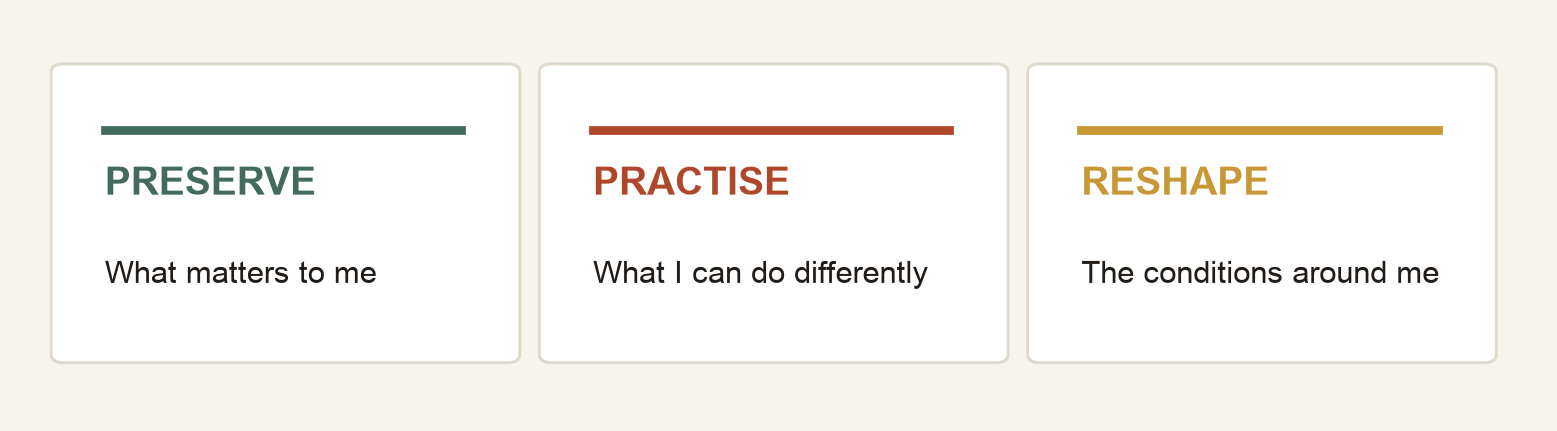
What should I preserve, what should I practise differently, and what needs to change around me?
Three questions to carry into change
Inside this report
Start with the two-minute summary. Explore self-understanding, culture, work, family, money and belonging. Use the new practice tools to test an idea, replace an old pattern and sustain progress through changing circumstances. Finish with a 90-day plan and a worksheet.
About this report. Prepared for Africa Global Forum, drawing on the reader-supplied Solved guide and podcast transcript, published research and original analysis. The examples and exercises are clearly identified as illustrations. [1] [11]
Section 01There is more than one African journey
“Abroad” also means another African country. IOM's World Migration Report 2024 reports around 21 million people living in another African country in 2020. This is a historical migrant stock, not an annual flow or a current count. [9]
A move from Senegal to Côte d'Ivoire, Zimbabwe to South Africa or Uganda to Kenya can involve changes in language, status, rules and belonging. A move to Europe, North America, the Gulf or Asia creates other combinations of opportunity and constraint. Distance alone does not measure the size of a transition.
| Situation | What a useful change plan must consider |
|---|---|
| Preparing to move | Expectations, verified requirements, costs, support and alternatives if the original plan fails. |
| Studying or working away | Local systems, recognition of skills, relationships, workload and conditions of residence. |
| Joining a partner or family | Each person's independence, career, friendships, care work and access to resources. |
| Returning or moving again | Current conditions at the destination and the expectations of people who remember an earlier version of you. |
| Staying in your home country | Changing work, family roles, technology, health and economic conditions without treating migration as the only route to progress. |
Different starting points, different choices
Someone relocating voluntarily with savings has different options from a displaced person, a worker dependent on an employer or a student supporting relatives. Citizenship, race, gender, disability, age, language and class can all shape the available choices.
Africa is not a single culture, and migration is not one experience. This report offers questions to adapt, rather than a standard African personality or a universal adjustment timetable. A successful transition can mean advancement, greater stability, a safer life or simply getting through a difficult period with support.
Section 02What exactly are you trying to change?
The Solved guide distinguishes broad personality tendencies, learned adaptations and observable behaviour. It presents this as an organising simplification. [1] That distinction can prevent a specific difficulty from becoming a verdict on your whole identity.
“I did not speak in that meeting” describes an event. “I am incapable of leadership” turns it into a life sentence. A more useful experiment is to prepare one question and ask it in the next suitable meeting.
Figure 1. Choose the right target
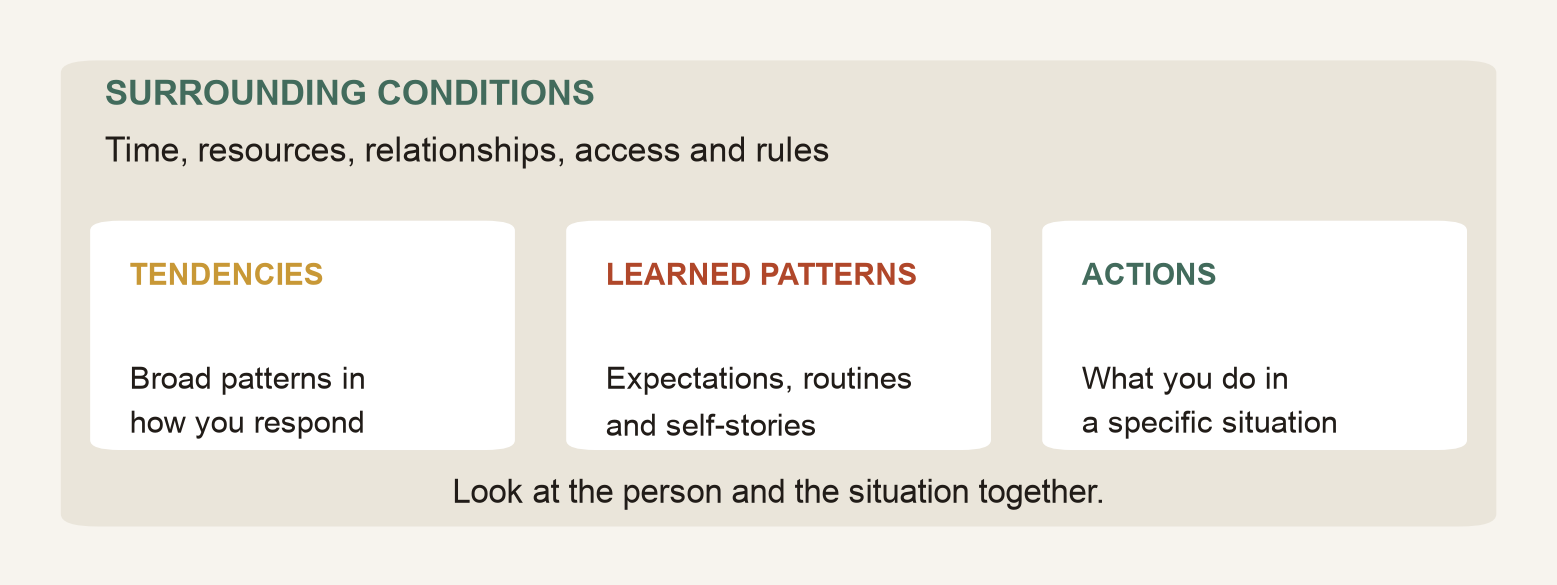
The surrounding conditions deserve equal attention. COM-B, a behaviour-change framework, asks about capability, opportunity and motivation. Wanting to attend a course is insufficient if the schedule conflicts with work or the materials are inaccessible. [2]
Tendencies are not destiny
A review of 207 studies, primarily involving clinical interventions, found changes in personality trait measures. It does not promise that a self-help exercise will transform anyone's personality. It does challenge the idea that adults are permanently fixed. [3]
You can stretch for a purpose without demanding a new personality. A quieter person might prepare for important conversations and allow recovery afterwards. The aim is useful action, not performing someone else's ideal character.
Section 03A personality score is a starting point for questions
The podcast's discussion of labels raises a useful question: does a description help you understand a pattern, or close off possibilities before you have tried them? [11] “I prefer smaller groups” can guide a networking plan. “People like me cannot lead” makes a much larger claim.
If you want to take a personality test
A researched dimensional measure such as the Big Five Inventory-2 can support reflection. Its domains describe openness, conscientiousness, extraversion, agreeableness and negative emotionality, with more specific facets underneath. These are dimensions, not five types of people or a ranking of human worth. [12]
Check who developed the questionnaire, whether its language version and intended population have been studied, and how its scoring is explained. Consider the result alongside examples from your life and feedback from someone who knows you. It is not a diagnosis or a sufficient basis for choosing a career, partner or country.
Culture matters to measurement
Research using surveys across 23 low- and middle-income countries found substantial challenges in recovering the expected Big Five structure. Language, response patterns and administration deserve attention; validation in one setting cannot simply be assumed everywhere. This is a measurement warning, not a claim that Africans lack the traits. [13]
You can begin without a test
For a week, note the situation, your response, how it felt and what helped. Compare contexts: close friends and strangers; a familiar language and a newer one; a rested day and an overloaded day. These are observations, not a validated assessment.
| Observation | A question worth investigating |
|---|---|
| Quiet in a new workplace, expressive with friends | Is the difficulty preference, language effort, unclear expectations or the cost of speaking up? |
| Organised at work, overwhelmed by personal paperwork | What structure, time or support exists in one setting and is missing in the other? |
| More at ease in a small group | Could recurring small-group contact serve the goal better than large events? |
Describe patterns precisely and leave room for new evidence. Traits can be relatively stable and still change; a score does not establish your permanent limits. [3]
Section 04A full week cannot absorb unlimited change
Plans often count the hours of a course and overlook the work of making a life function: travel, meals, care, paperwork, appointments and calls across time zones. These activities consume capacity even when they do not appear on a CV.
Figure 2. What room is left in the week?
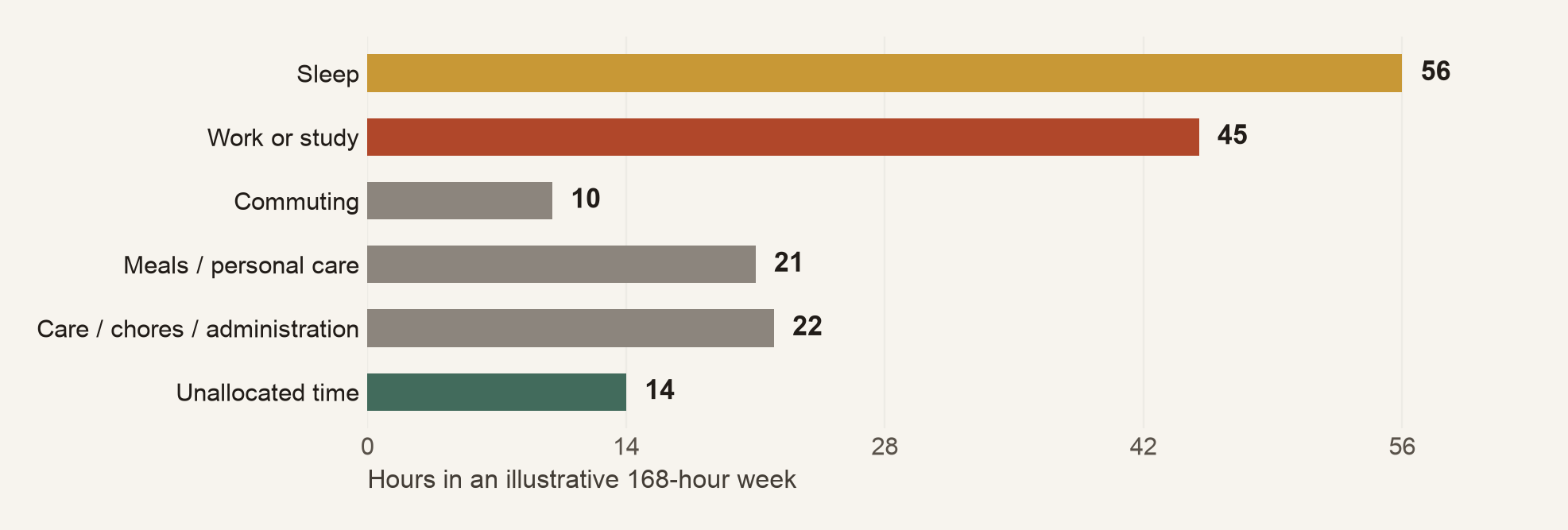
In this invented example, 154 hours are already allocated. The remaining 14 hours include rest, relationships, unexpected tasks and learning. Adding a ten-hour course would leave four hours for all of those purposes, unless another commitment changes.
Budget for friction, not only the ideal week
Before adding a commitment, identify what you will reduce, share, postpone or stop. Treat rest as a real need; a free hour on a calendar is not necessarily an hour of concentration. Where possible, retain some unallocated time for disruptions.
A useful resource is room to choose: enough practical support, time or financial margin to try something without one setback undoing everything. Not everyone can create this alone. An affordable bus route, predictable shifts or an accessible public service can expand that room.
This week's exercise: record where your time actually goes for seven days. Choose one source of avoidable friction before choosing another goal. If essentials already consume the week, the next step may be asking for help or renegotiating a workload.
Section 05Your skills and your recognition may move at different speeds
A qualification can cross a border while its professional recognition does not. Difficulty securing suitable work should prompt investigation of the process, not an automatic conclusion that your skills have disappeared.
Figure 3. Education does not guarantee suitable work
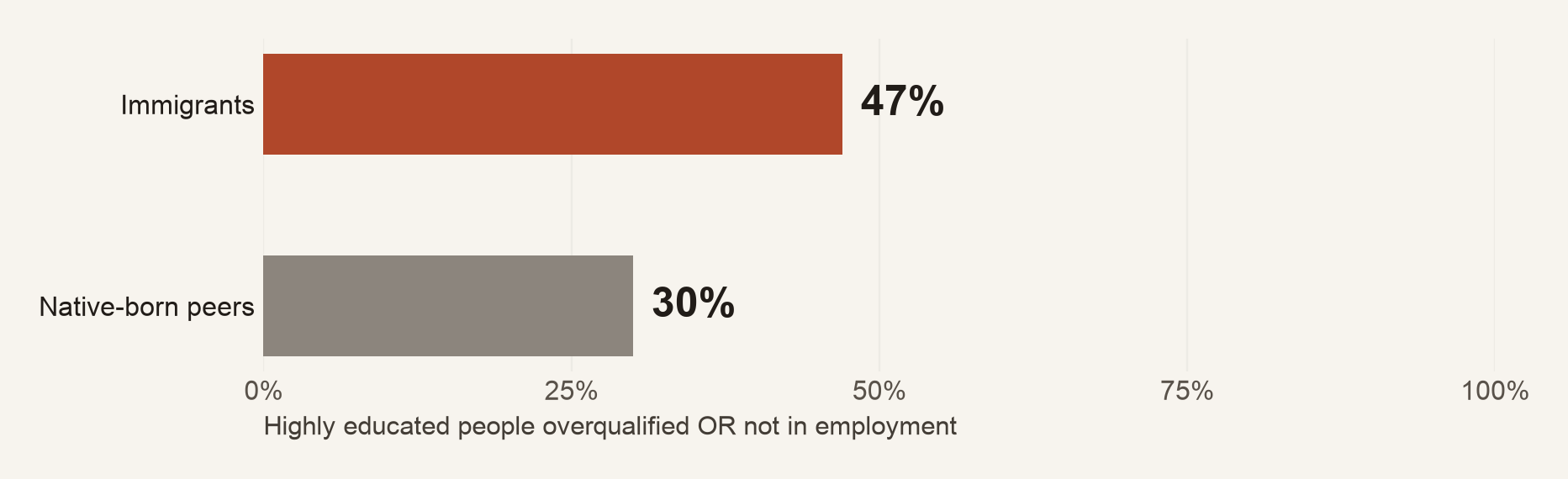
These EU figures concern highly educated migrants of all origins. They neither measure Africans separately nor explain any individual's experience. They show why the conversion of education into suitable work deserves attention. [5]
Build a route from experience to evidence
Identify the actual obstacle: formal recognition, language, a missing skill, limited contacts, a hiring requirement or discriminatory treatment. Ask a relevant professional body or careers service what is mandatory and what is merely preferred before buying another qualification.
Where feasible, maintain two tracks: current income and longer-term progression. A temporary job can support a transition; review whether its hours and costs still leave a workable route forward. Keep examples of your work, request specific feedback and learn how your field communicates evidence of competence locally.
For students, supplement grades with work you can explain: a project, research contribution, placement or community activity. Check the rules for any work or placement before committing. Professional confidence can grow from evidence of capability, even while recognition remains incomplete.
Section 06Keep the commitment; renegotiate the arrangement
A new salary can create an old expectation at a larger scale: if you earn abroad, you must be able to solve more problems at home. But salary converted into another currency does not reveal rent, deductions, debt, care costs or uncertainty.
For some families, mutual support is a source of security and meaning. The question is how to make it sustainable and fair. Treat relatives as people with priorities and knowledge, rather than passive recipients of a plan made elsewhere.
| Value worth preserving | Arrangement worth discussing |
|---|---|
| Care for family | What support is feasible, when it arrives and what happens during a difficult month. |
| Shared responsibility | Who contributes money, time, local coordination or care, including work that is currently invisible. |
| Respect | How requests are made and how a delayed answer or a refusal is handled. |
| Future security | Which present commitments leave room for health, education, retirement and other long-term needs. |
A conversation that makes change concrete
“I want to remain dependable. Here is what I can commit to for the next three months. For requests beyond that, let us discuss the options before anyone makes a promise. We can review this together on this date.”
The amount is personal; this report proposes no universal remittance percentage. A predictable arrangement may help planning, but it cannot make genuine need disappear. Emergencies require judgement and, where available, wider sources of support.
Discuss money and care within the household abroad as well. A partner who loses career continuity or does more unpaid work has also absorbed a cost of migration. Neither the highest earner nor the person abroad should automatically control every decision.
Progress can mean becoming more reliable with fewer promises. It can also mean accepting support yourself. Your value to loved ones is larger than your ability to transfer money.
Section 07You can welcome the opportunity and miss the life you left
You may miss being known without explanation: humour that lands immediately, people who recognise your history, familiar food or an ordinary visit that requires no planning. Missing these things does not invalidate the decision to move.
The Solved guide makes room for the losses involved in change. [1] Here, that idea is a prompt for reflection, not a compulsory series of emotional stages. You do not owe anyone a story in which every loss becomes a lesson.
WHO's review of migrant mental health identifies community, identity, security and access to services among relevant factors. [6] Belonging therefore deserves practical attention alongside study, employment and administration.
Build several kinds of connection
- Someone who knows your history: a person with whom you do not have to perform constant success.
- Someone who understands local systems: a colleague, neighbour, association or service that can help you find reliable information.
- A recurring place to participate: a class, interest group, faith community, sports club or volunteer activity that suits your preferences and circumstances.
- Qualified support when needed: someone equipped to help with a health, legal, employment or other specialist difficulty.
In a qualitative study of 16 African international students at one South African university, participants described positive relationships with local and other immigrant students. The researchers also highlighted the importance of spaces for interaction. This small study illuminates experiences; it does not represent all African students. [8]
Choose connections for mutual respect and reliability. Shared nationality does not guarantee support, and friendship need not depend on abandoning cultural familiarity.
Some people experience substantial or persistent distress. If it is affecting everyday functioning, seek appropriate local professional support. Access, language and cost can be obstacles; a trusted community organisation or student service may help identify options. Asking for care need not wait until a situation becomes a crisis.
Section 08Adaptation does not require self-erasure
Learning how a workplace communicates can improve your effectiveness. Believing that your name, accent, background or culture makes you less capable can diminish your sense of self. These are different matters and deserve different responses.
A useful question is: does this change improve how I live or work, or mainly make me easier for someone else to accept? The answer may be mixed. Sometimes you make a pragmatic compromise because the cost of resisting is high. That does not make the underlying demand fair.
Decide what to keep, change and question
Keep: values and practices that sustain you or express the person you want to be. These might include family connection, language, faith, hospitality, creativity or independence. No list belongs to every African.
Change: a method that no longer serves those values. If answering every message immediately damages your studies and sleep, a regular call can preserve closeness through a different routine.
Question: the standard by which you judge your life. A friend's house, promotion or citizenship milestone does not reveal their resources, obligations or trade-offs. Ask whether the target is useful for your circumstances before turning it into a deadline. Would you still value it if nobody could see the result? Which responsibilities do you endorse, and which expectations need discussion?
Relationships may need time to catch up
Explain the behaviour that is changing and the commitment that remains. “I am less available during the week, but I still want us to talk on Sundays” gives others something concrete to understand.
Disagreement is not automatically sabotage. Someone may be worried, inconvenienced or missing the old arrangement. Listen, repair harm where you caused it and make agreements clearer. Where there is coercion or abuse, safety and appropriate support take priority over preserving the arrangement.
Belonging in more than one place does not require becoming identical in every setting. You can develop a broader repertoire while retaining a recognisable set of values.
Section 09The same behaviour can be read differently
A move can change how other people interpret you before it changes how you understand yourself. Silence may express respect, concentration, uncertainty about language or concern about consequences. Direct speech may be intended as clarity and received as disrespect, or welcomed as participation.
These are possible interpretations, not national characteristics. Families, workplaces, generations and professions differ within every country. The following examples are AGF discussion prompts, informed by the report's attention to context and opportunity. [2] [6]
| Situation | What to clarify | An action to try |
|---|---|---|
| A seminar or team meeting | How are questions invited? Are written contributions accepted? | Prepare a question and ask the facilitator about participation expectations. |
| Disagreement with a supervisor or elder | What language conveys both respect and a clear concern in this relationship? | Explain the shared aim, then name the issue and a possible next step. |
| A request from relatives | Is it urgent, expected, negotiable or already promised to someone else? | Clarify the need before committing; agree what you can reliably do. |
| Children or partners adapting at different speeds | What does each person want to preserve, and what feels difficult? | Discuss one recurring situation without making one person's experience the family standard. |
Learn a wider range of responses
You may be quiet and effective in one setting, more direct in another, and comfortable using different languages or customs with different people. Flexibility does not automatically mean dishonesty. Ask whether the adjustment serves a purpose you accept and whether its cost is sustainable.
A student who begins speaking in class may still prefer a small social circle. A worker who learns to state an achievement clearly can still value modesty. The aim is to expand useful choices, not to declare one cultural style superior.
Distinguish learning from unfair demands
Request concrete feedback: “Which part was unclear, and what would a useful contribution look like?” Vague demands to “fit in” are harder to assess. If the issue is discrimination, exclusion or unsafe power dynamics, individual rehearsal is only one possible response; fair procedures and appropriate support also matter. [7]
Section 10What need was the old behaviour meeting?
The transcript highlights that changing one pattern can affect several parts of life. A routine may provide social contact, relief, predictability or a valued role as well as creating problems. Removing it can leave a practical or emotional gap. [11]
This is a question to investigate, not a claim that every difficulty comes from childhood or that every harmful action has a single hidden cause. Ask: what does this response help me obtain, avoid or preserve, and is that still needed?
| Pattern to reconsider | Possible need to investigate | A replacement to discuss or test |
|---|---|---|
| Saying yes to every request | Belonging, dependability or avoiding conflict | A clear commitment, a review date and other ways to stay involved. |
| Working through every evening | Security, professional identity or fear of falling behind | Clearer priorities and one protected period, where working conditions allow. |
| Staying only within a familiar circle | Language ease, trust or relief from explaining yourself | Keep valued relationships while adding one recurring connection elsewhere. |
| Avoiding questions at work | Respect for authority or protection from embarrassment | A prepared question, private clarification or written follow-up. |
These examples are hypotheses for reflection, not diagnoses. Avoiding a question may be sensible in an unsafe workplace. The relevant change could be protection or a fairer process, not greater personal boldness.
Plan for the consequences of improvement
Before reducing a commitment, ask who depends on it and what agreement is needed. Before leaving an activity, ask where its companionship or enjoyment will come from. A new study routine may require a childcare agreement; reducing constant availability may require a predictable way to stay close.
Feelings and actions may move at different speeds
You may make a considered boundary and still feel guilty. You may ask a useful question while nervous. Notice the feeling, the action and the consequences separately. Discomfort alone does not establish either failure or progress; check whether the action is safe, fair and useful.
Preserve the need where it still matters, while exploring a more workable way to meet it. Understanding a pattern is valuable; trying an alternative gives you further evidence.
Section 11Replace the transformation deadline with a workable practice
An influential habit study followed 96 volunteers for 12 weeks as they repeated a chosen eating, drinking or activity behaviour. Estimated time to approach a stable level of automaticity varied widely. [4]
Figure 4. A range, not a deadline
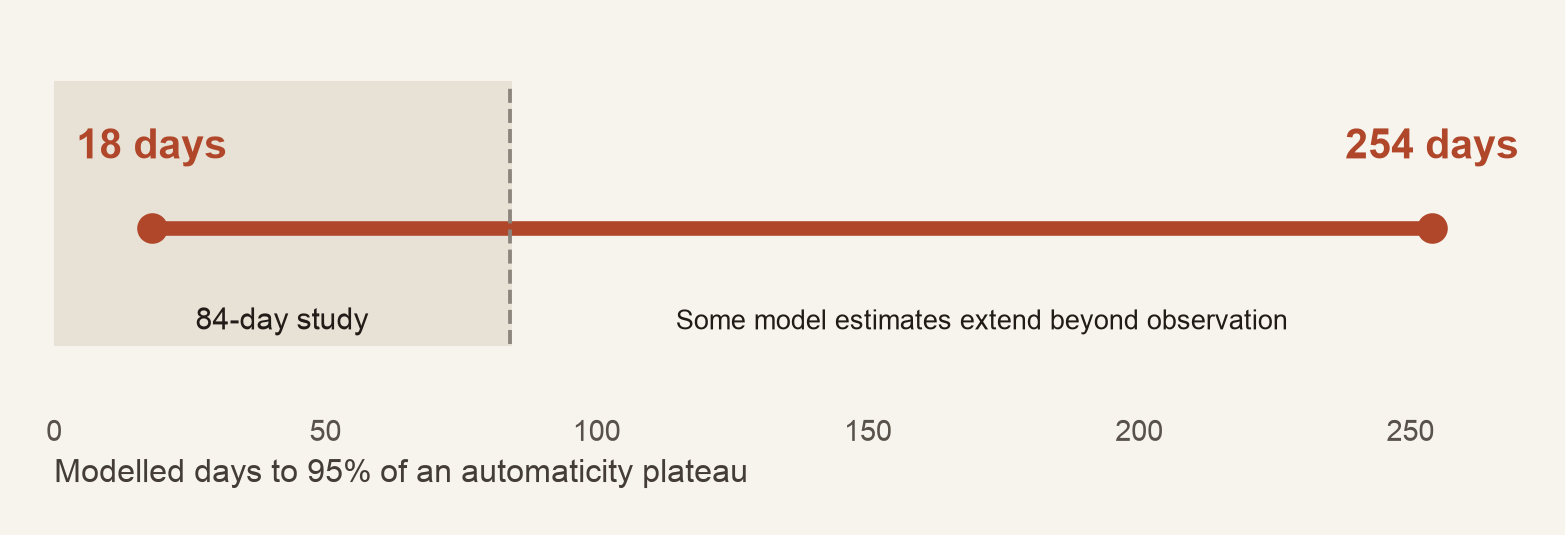
This finding concerns relatively simple behaviours. It does not tell us how long it takes to belong, recover from loss, change a career or settle in a country. Use it to question rigid deadlines, not to set a new one.
Design one repeatable action
Choose a cue that already occurs, a small action and a fallback. For a shift worker: “After my first meal, I will practise five useful phrases. On a difficult day, I will review one.” For a student: “After opening my notes, I will answer one question without looking.”
Make the materials available in advance. If internet access or data costs are obstacles, download lawful offline material when possible. Ask one person to check in at an agreed interval if that would help.
Record attempts and what interrupted them. At a weekly review, change the design before attaching a character judgement. An unrealistic cue, fatigue or an unavailable resource is information you can use.
Plan the restart before you need it: at the next suitable opportunity, do the smallest useful version. A routine should help you live; maintaining a perfect streak is not the purpose.
Section 12Give a useful insight a place to become practice
Recognising a pattern can feel significant. The transcript also warns that repeatedly explaining it can become a substitute for trying something different. [11] For a reader studying or working abroad, the next useful question is: what could I do, with appropriate support, that would help test this understanding?
Figure 5. Turn reflection into a testable next step
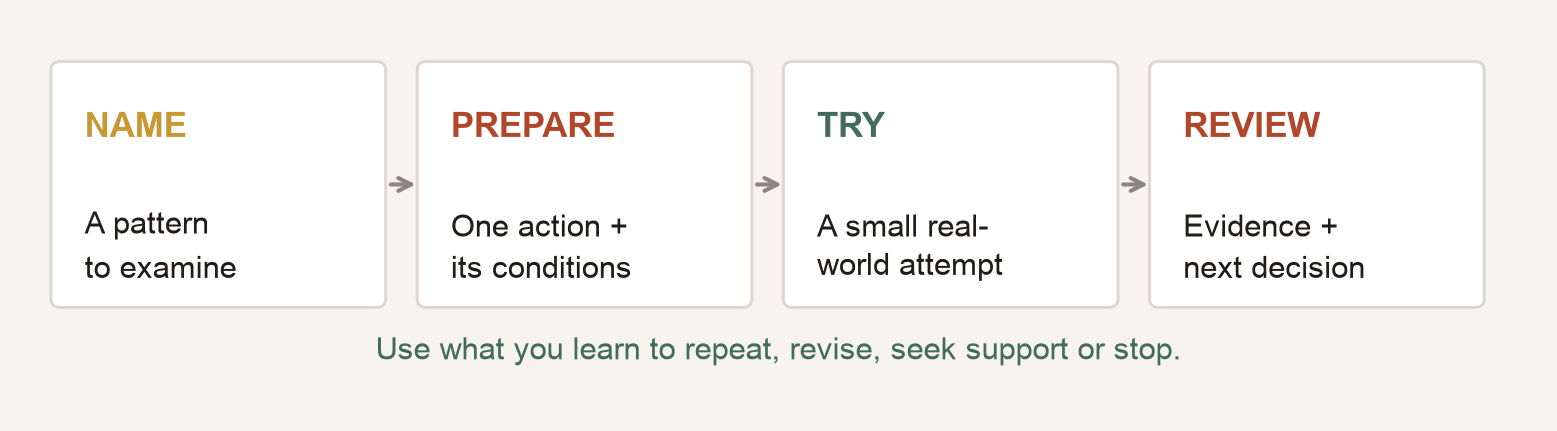
An illustrative seminar experiment
The starting story is “I have nothing useful to say.” Choose a narrower action: after reading, prepare one question. Check expectations with the tutor and arrange a suitable opportunity to ask it or contribute in writing. After four sessions, review what happened and what feedback you received.
Research on implementation intentions supports specifying a situation and a response: if this situation occurs, I will take this action. Results depend on the behaviour and circumstances; planning cannot create missing permission or resources. [15]
Record three different things
Action: did I make the attempt? Conditions: was there a fair opportunity, enough preparation and useful support? Outcome: did the contribution help my learning or become clearer with feedback?
Record feelings separately. Anxiety does not erase a completed attempt, and feeling confident does not prove the work was effective. If feedback is unclear or unfair, seek another appropriate source of evidence.
One action will not settle your identity. It can tell you something more specific about a skill, a setting or the support you need. Review before adding more goals.
Section 13Build a routine that can travel with you
The transcript distinguishes starting a change from maintaining it. [11] This matters when your life moves between countries, households, shifts or time zones. A practice that works in one setting may depend on conditions that disappear in another.
Habit research links repeated responses with recurring contextual cues. [14] Applied to diaspora life, this suggests checking familiar places, schedules and social expectations when an old response returns. A difficult visit home does not, by itself, prove that all previous progress has vanished.
Before a visit or a change of routine
Name a likely pressure: requests during a family gathering, no quiet workspace, shared meals, disrupted sleep or limited connectivity. Choose what matters enough to preserve and what can reasonably pause. Discuss shared arrangements before assuming other people will organise around your plan.
For example: “If a request exceeds what I can commit to, I will take time to check before answering.” Or: “If my usual study slot disappears, I will review one saved exercise after my first meal.” These are original planning examples, not guarantees.
Maintain the connection as well as the boundary
Relatives may interpret a new routine as distance or a changed attitude. Explain the commitment that remains: “I still want us to spend time together; I need to finish this work first.” Listen to what the change costs them, too. Disagreement alone does not establish sabotage.
Choose supportive people for trust and practical help, including people whose lives differ from yours. A change in ambition need not become a judgement on everyone who has made another choice.
Give the change a reason you can endorse
Ask what it enables: learning, health, friendship, care, creative work, independence or contribution. Family responsibility can be a freely valued purpose as well as a source of pressure. People with or without children deserve reasons that fit their own lives.
After a disruption, review the action, the conditions and the cost. Resume a manageable version, revise the arrangement or seek help. If the original goal no longer serves your life, reconsidering it can be part of responsible change.
Section 14Seven situations, seven different change plans
The following are invented scenarios for discussion. They are not interviews, national profiles or claims about typical outcomes.
A Tanzanian business owner staying at home. Customers are asking for digital ordering. They test one simple process with existing customers, retain a paper fallback and assess costs and reliability before changing the whole operation. Staying in the same place still calls for adaptation.
A Senegalese graduate working in Côte d'Ivoire. They have experience but few local professional contacts. Instead of another broad course, they seek feedback on one work sample and attend a recurring sector meeting. The review question: did this clarify a real skill gap or a hiring route?
A Zimbabwean student in South Africa. They are keeping up academically but feel socially isolated. They try a small weekly study group and contact the relevant student service. The aim is repeated, manageable contact, rather than pressure to become outgoing overnight.
A Kenyan employee in the Gulf. They want to retrain around changing shifts. The plan starts with clarifying their schedule and checking applicable work and study conditions through reliable local channels. Offline lessons follow an event-based cue. Advice to “just quit” would ignore the consequences of their circumstances.
A Nigerian professional in Canada. Their previous role is not immediately accessible. They investigate credential requirements, preserve evidence of earlier work and set a review date for the temporary job funding the transition. They distinguish professional recognition from personal worth.
A Moroccan parent in France. A move has redistributed childcare and interrupted one partner's career. The household maps paid and unpaid work before adding a new qualification. Progress requires agreement on care and resources, not only better time management by one person.
A Ghanaian professional considering a return from the UK. They compare current opportunities and family needs in both places. Where feasible, conversations and a limited visit test assumptions before a permanent commitment. Returning is assessed as a next decision, rather than a public verdict on the earlier move.
The common question
What is the smallest useful action, and what conditions would make it possible? The examples differ because practical advice has to begin with a person's circumstances.
Section 15Sometimes the first task is to protect what still works
Job loss, bereavement, illness, conflict, a relationship ending or an immigration decision can force change before you feel ready. In these circumstances, a demand to reinvent yourself can become another burden.
Start with the immediate priorities: safety, food, housing, care, essential documents, urgent deadlines and a person or service that can help. Where decisions have legal consequences, establish the facts with the relevant authority or a qualified local adviser. A motivational plan cannot substitute for rights, income or protection.
Three questions for a difficult week
What must be addressed now? Identify the few matters where delay could cause serious harm or remove an option. Write down verified deadlines and who can help with each.
What can be simplified temporarily? Reduce optional commitments, lower the standard for non-essential tasks and communicate changes where possible. Continuing one familiar, manageable routine may provide continuity.
What should wait until there is better information? Avoid treating pressure to decide as proof that a decision must be made immediately. Some choices genuinely are urgent; others become clearer with advice, rest or one missing fact.
WHO documents how insecure status, financial barriers, discrimination and administrative difficulties can affect migrants' health and access to services. [7] These conditions require responses beyond individual resilience.
Do not turn suffering into a qualification
A crisis is not something to seek in order to grow. Nor does pain establish that a decision is wise. Growth, distress, relief and grief can coexist; there is no obligation to produce an inspiring ending.
For immediate danger, seek locally available emergency help. For continuing distress or a loss of everyday functioning, consider qualified health support. Ordinary self-help exercises should not become a substitute for needed care.
Sometimes a meaningful change is a smaller workload, safer conditions or permission to stop doing something that is harming you.
Section 16Staying, returning and starting again are decisions
The years and money already invested in a path matter to your history. They do not, by themselves, establish that the next year should look the same. Equally, a hard month does not establish that an entire move was a mistake.
Compare realistic next steps from your present position. Include the likely cost of staying, switching or waiting, and the consequences for people who share your life. Seek country-specific advice where residence, employment, tax or benefits are involved.
| Question | Evidence to gather before deciding |
|---|---|
| Can this life become sustainable? | Actual costs, workload, care needs and the changes realistically available. |
| Is the proposed alternative real? | Current opportunities, eligibility, housing and a credible plan, rather than memories or online success stories. |
| Can I test an assumption first? | A conversation, project, short course or visit where feasible and permitted. |
| What would change my decision? | A specific offer, deadline, health consideration or family need, with a date to reassess. |
Include the people whose choices are less visible
A child's attachments, a partner's profession, an older relative's care or your own disability-related support can alter the decision. “Home” may mean different places to different members of the same household. Name these differences before treating a move as an agreed family goal.
If you return, allow for the possibility that both you and the place have changed. Rebuild everyday relationships and check current conditions rather than expecting an earlier life to resume intact.
Retirement is also a transition in routine, identity and contribution. People with or without children can plan for friendship, care, meaningful activity and financial continuity. A life does not need a particular family structure to be worth planning for.
A good next step should expand or protect the choices you value, not merely preserve the appearance that an old plan is working.
Section 17Use tools to practise, then test yourself in the world
AI can be used to draft a study plan, rehearse a conversation, generate practice questions or organise a complex task. These are possible uses, not guarantees of accuracy or better outcomes. UNESCO's guidance places human agency and data privacy at the centre of responsible educational use. [10]
For someone adjusting to a different professional or academic environment, a useful sequence is attempt, feedback, revision, demonstration. Make an attempt yourself, use tools to challenge it, verify important information and show what you can do without relying on a fluent answer you do not understand.
Three prompts that lead towards action
“I have 20 minutes after my evening meal. Help me break this learning goal into one activity I can practise and check. Ask about constraints before suggesting a schedule.”
“Role-play a respectful conversation about a family commitment I need to change. Give several possible responses; do not assume my family is unreasonable.”
“Critique this explanation. Separate factual claims I must verify from suggestions about clarity. Ask me questions to check whether I understand it.”
Use hypothetical or anonymised details. Avoid entering confidential workplace material or sensitive identity and immigration records into tools without an appropriate, authorised basis. Check institutional rules and consult official sources or qualified advisers for consequential decisions.
Do not automate away the learning
A polished application does not establish a skill. A generated plan does not create time. A convincing legal answer does not establish permission. Use output as a draft to examine, not evidence that the underlying work is complete.
Keep a record of what you have actually learned or produced, including feedback and revisions. Ask: can I explain this, check it and use it in a new situation?
The useful outcome is greater capability after the task, not only a faster-looking result. If planning repeatedly replaces action, reduce the next step until you can put it in front of a person, a real problem or a meaningful test.
Section 18A 90-day plan for one meaningful change
This is an original AGF planning tool. The dates create review points, not a scientific timetable for habits, integration or emotional recovery. Adapt the pace to your circumstances; urgent needs take priority.
Figure 6. Review points for a first experiment
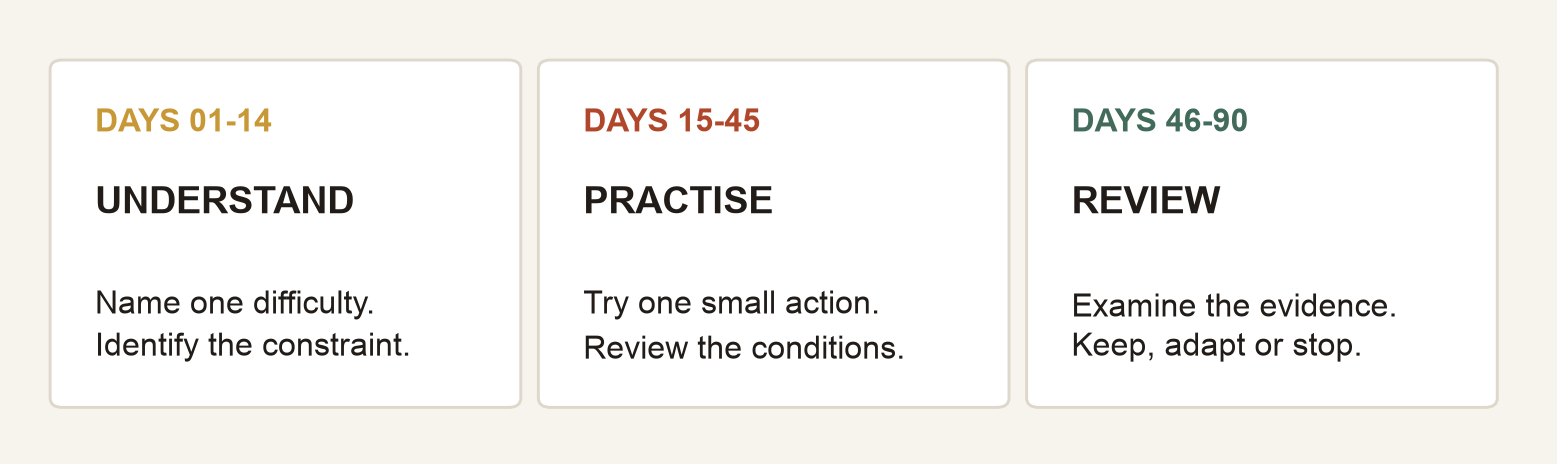
Days 1-14: understand the situation
Describe one difficulty in observable terms. Record a typical week and identify the main constraint. Choose one value you want to preserve and investigate the need your current response may be meeting. Check any relevant requirements or deadlines. Ask one person or service for the missing information or support.
Days 15-45: practise and adjust
Choose one small action and an existing cue. Arrange the materials and support it needs. Describe the first observable attempt; record actions and feelings separately. Agree one conversation if another person's cooperation is necessary. Review weekly: what happened, what got in the way and what needs changing?
Days 46-90: examine the result
Look for evidence beyond effort. Has work become clearer, a relationship more predictable, a skill more usable or a barrier better understood? Keep what helps, adapt what does not and stop an approach whose costs outweigh its value. Decide how to maintain progress during travel, busy periods or schedule changes.
Measure three things separately: the action you attempted, the conditions that supported or blocked it, and the outcome you care about. Outcomes also depend on other people and institutions; activity alone cannot guarantee them.
At day 90, the question is not “Am I a new person?” It is “What do I now know, what is working, and what is the next sensible step?”
Section 19One page to turn reflection into a decision
Write short answers. Choose one priority; leave other goals for later. This is a reflection aid, not a diagnostic test or a score of your worth.
| Prompt | Your answer |
|---|---|
| The situation I want to improve | ____________________________________ |
| Why it matters; the need I want to preserve | ____________________________________ |
| A value or connection I want to preserve | ____________________________________ |
| What I can act on directly | ____________________________________ |
| What needs agreement with someone else | ____________________________________ |
| A barrier requiring advice or institutional action | ____________________________________ |
| One small action and its cue | ____________________________________ |
| Time, resources or support it needs | ____________________________________ |
| What I will reduce or pause to make room | ____________________________________ |
| My fallback during a difficult week or visit | ____________________________________ |
| Evidence that would show useful progress | ____________________________________ |
| Review date and person to check in with | ____________________________________ |
At the review
What did I do, and how did it feel? What did the circumstances allow? What happened to the need the old pattern served? Should I continue, adapt, seek help or stop?
Example: “I want to participate more confidently in seminars. I will prepare one question after reading the assigned material. I will ask the tutor about expectations, practise with a peer and review after four sessions.”
This example turns a broad demand to “be more confident” into something observable. It also leaves room to discover that the difficulty lies partly in expectations, access or the learning environment.
Section 20People need opportunities to change, too
If institutions invite people to adapt while leaving avoidable obstacles in place, personal-development advice is incomplete. The following are AGF recommendations, informed by the distinction between motivation and opportunity, and by evidence on migrant access and support. [2,7,8]
| Who can act | A concrete change | A useful measure |
|---|---|---|
| Employers | Publish role expectations, offer clear induction and make recognition and progression criteria visible. | Time to clarity on requirements; progression and retention patterns; confidential feedback. |
| Universities | Connect academic guidance, international-student support and recurring opportunities for interaction. | Whether students find and use support; unresolved barriers; continuity beyond welcome week. |
| Diaspora and community groups | Combine encouragement with practical navigation, peer introductions and reliable referrals. | Whether participants resolve a stated problem or gain a dependable source of support. |
| Public bodies and professional regulators | Explain requirements plainly, reduce avoidable duplication and provide routes to query decisions. | Processing time, unresolved cases, accessibility and clarity of responses. |
Do not make the person seeking help repeatedly retell sensitive experiences to prove they deserve it. Gather only necessary information, protect confidentiality and let participants define what useful progress means to them.
A practical role for Africa Global Forum
AGF could pilot small, facilitated discussions built around one problem, one action and a later review. Invite students, workers, partners, returnees and people staying in their home countries. Where relevant, connect the discussion to qualified local services.
Start by testing whether the format helps participants identify a workable next step. Attendance, enthusiasm and moving testimonials are not enough to establish impact. Learn from who cannot attend and whose barriers remain unresolved.
The ambition is a life that becomes more liveable and more your own, with enough support to sustain it. Progress can be a new opportunity, a steadier routine, a repaired agreement or the freedom to choose a different direction.
Section 21A checklist also needs resources and permission
The podcast uses hospital checklists to illustrate how a simple prompt can improve follow-through. [11] The original research contains a more useful lesson for organisations: the checklist was part of a wider system.
In the intervention reported by Pronovost and colleagues, teams received education and feedback, essential supplies were organised, unnecessary catheters were reviewed, and staff could stop non-emergency procedures when infection-control practices were missed. The study reported reduced infection rates. It did not isolate the effect of a sheet of paper from the other changes. [16]
Apply the principle to support for migrants
AGF's interpretation is that an instruction becomes more usable when a person has the means and authority to act on it. The following are proposed service improvements, not results tested by the hospital study.
| Advice people hear | Conditions that help them follow it |
|---|---|
| “Ask for help early.” | A named contact, understandable information, confidentiality and a reliable response. |
| “Participate more.” | Clear expectations, accessible materials and a fair opportunity to contribute. |
| “Develop your skills.” | Realistic time, affordable access, necessary equipment and clarity about recognition. |
| “Speak up when something is wrong.” | A safe reporting route, protection against retaliation and someone responsible for responding. |
An employer can offer communication training while still penalising questions. A university can promote wellbeing while leaving students unsure how to obtain support. The inconsistency itself becomes a barrier.
A question for every programme
Before asking people to change their behaviour, identify what the organisation must change to make the request realistic. Assign responsibility and review whether people can actually use the support.
For an AGF discussion group, record one participant-chosen action and one condition needed to make it possible. At the next meeting, examine both. Success includes resolving a barrier or finding appropriate support, not simply collecting promises to try harder.
Sources and evidence notes
This report is an editorial research synthesis, not a systematic review or an evaluated intervention. It combines the reader-supplied Solved guide and podcast transcript, selected research and official reports, and original AGF analysis. The transcript supplies themes, not independent verification of its scientific claims; sponsor material is excluded. Sources were checked on 8 October 2026. Publication and observation dates are shown separately.
The numerical findings concern different populations and cannot be combined into an estimate for Africans abroad. Scenarios are invented. Practical tools are suggestions to adapt, not a diagnostic assessment or a universal timetable. Country-specific legal, financial and clinical questions require appropriate local information.
- Solved with Mark Manson. Your guide to Change / Change, Solved. (2026)
Reader-supplied SOLVED-Change-Guide.pdf, 82 physical pages. Conceptual starting point, especially physical pages 14-18, 27-31, 41-44, 48-53 and 65-81. The guide describes its three-layer model as a simplification of personality research. This AGF report is an independent adaptation, not an endorsement by Solved. - Michie, S., van Stralen, M. M. and West, R. (2011). The behaviour change wheel: A new method for characterising and designing behaviour change interventions
Implementation Science, 6, 42. Introduces COM-B: capability, opportunity and motivation as conditions for behaviour. A framework for analysing behaviour, not proof that the exercises in this report improve migrant outcomes. - Roberts, B. W. et al. (2017). A systematic review of personality trait change through intervention
Psychological Bulletin, 143(2), 117-141. Review of 207 studies, primarily clinical interventions. Changes in trait measures were observed; designs and populations varied. Does not establish a universal timetable or guarantee change from self-help. - Lally, P., van Jaarsveld, C. H. M., Potts, H. W. W. and Wardle, J. (2010). How are habits formed: Modelling habit formation in the real world
European Journal of Social Psychology, 40, 998-1009; first published online in 2009. 96 volunteers, 12 weeks; 82 provided sufficient data, models fitted for 62 and fitted well for 39. The 18-254-day range concerns modelled time to 95% of an automaticity plateau, not observed completion of life transitions. - OECD / European Commission (2023). Indicators of Immigrant Integration 2023: Settling In, section 3.12
EU-wide, 47% of highly educated immigrants were overqualified or not in employment, compared with 30% of native-born peers. Combined indicator; not an unemployment rate, not an African-specific estimate and not 2026 data. The report primarily describes conditions around 2021, with source-year variation. - World Health Organization (2023). Mental health of refugees and migrants: risk and protective factors and access to care
Global Evidence Review on Health and Migration. Reviews identity, community, security, adversity, cultural understandings and access to care. Diverse migrant and refugee populations; circumstances and service availability differ. - World Health Organization (2022). World report on the health of refugees and migrants
Documents legal, administrative, language, financial and discrimination-related barriers affecting health and access. Supports attention to institutions and conditions, rather than attributing difficulties solely to personal motivation. - Letsoalo, T. S., Chigeza, S. and Wilson Fadiji, A. (2024). An exploration of the relational well-being of African international students at a South African university
South African Journal of Higher Education, 38(4). Qualitative interviews with 16 students at one university. Highlights relationships and institutional spaces; an account of experiences, not a representative prevalence estimate or causal trial. - International Organization for Migration (2024). World Migration Report 2024: Chapter 3 key findings
Reports approximately 21 million intraregional international migrants in Africa in 2020 using UN DESA data. Historical stock, not annual migration, not all African migration and not a current 2026 count. - Miao, F. and Holmes, W. / UNESCO (2023). Guidance for generative AI in education and research
Guidance on human agency, privacy and responsible educational use. Supports the safeguards in the technology section; the practical prompts are original AGF suggestions, not evaluated interventions. - Solved with Mark Manson, reader-supplied transcript. Change episode: Change - Solve.pdf
451 physical pages, supplied by the reader. Relevant passages: pp. 93-109 on labels; 169-177 and 198-213 on learned patterns and their consequences; 265-269 on checklists; 289-295 on starting small; 418-435 on relationships and maintenance; 440-448 on reasons for change. Transcription errors, anecdotes and sponsor messages are not treated as research evidence. Concepts are independently adapted and checked where used. - Soto, C. J. and John, O. P. (2017). The next Big Five Inventory (BFI-2): Developing and assessing a hierarchical model with 15 facets to enhance bandwidth, fidelity, and predictive power
Journal of Personality and Social Psychology, 113(1), 117-143. Development and validation of a dimensional personality questionnaire with five broad domains and 15 facets. A research instrument, not a diagnosis, complete identity or universal guide to careers and relationships. - Laajaj, R. et al. (2019). Challenges to capture the big five personality traits in non-WEIRD populations
Science Advances, 5(7), eaaw5226. Analysed 29 face-to-face surveys with 94,751 respondents in 23 low- and middle-income countries and additional internet data. Found substantial measurement challenges in the face-to-face surveys. Results concern instrument performance and administration; they do not show that Africans lack personality traits or that all translated instruments are invalid. - Wood, W. and Neal, D. T. (2007). A new look at habits and the habit-goal interface
Psychological Review, 114(4), 843-863. Theoretical synthesis of habit learning, context cues and goals. Supports attention to recurring contexts. Applications to visits home, changing shifts and cross-border routines in this report are AGF interpretations, not outcomes tested by this paper. - Gollwitzer, P. M. and Sheeran, P. (2006). Implementation intentions and goal achievement: A meta-analysis of effects and processes
Advances in Experimental Social Psychology, 38, 69-119. Reviews plans specifying when, where and how to act. Supports using an if-then plan; it does not validate the AGF worksheets or guarantee results where resources, safety or permission are missing. - Pronovost, P. et al. (2006). An intervention to decrease catheter-related bloodstream infections in the ICU
New England Journal of Medicine, 355, 2725-2732. Multicomponent hospital safety intervention: education, supplies, a checklist, stopping non-emergency procedures when practices were missed, catheter review and feedback. Reported infection reductions cannot be attributed to the checklist alone. AGF draws an organisational analogy, not a numerical prediction for migrant services.
Build change you can sustain.
Share this report with someone navigating a new country, a changing role or a different chapter of life.